Some aircraft have stories that deserve to be told. Fairchild F24W-41A ZS-VWO is one of them.
Her story began during the Second World War when she started life on the civil production line as a Fairchild F24W-41A, construction number 285. When the RAF placed a large order for Fairchild aircraft, a number of aircraft originally destined for the civil market were transferred to the military production line. Cn 285 was one of these aircraft and became USAAF 41-38841.
Following completion, the aircraft was shipped to Britain where she entered RAF service as a UC-61 Argus, receiving the RAF serial number EV777. She was subsequently operated by the Air Transport Auxiliary (ATA), whose pilots performed the vital task of ferrying aircraft and personnel between bases. During this period, she was modified to Argus II standard.
With the end of hostilities, EV777 was sold in the United Kingdom rather than being returned to the United States, as some historical sources have suggested. She was registered G-AKJB and operated as a charter aircraft.
In January 1949, her owner, Eric Wm Brookhouse, and his wife embarked on an ambitious flight from Britain to South Africa. Their journey initially followed the west coast of Africa before turning inland through the Belgian Congo, continuing via Zambia and Rhodesia, and eventually reaching Durban, South Africa, towards the end of March 1949.
That remarkable journey is documented in a historical logbook kept by Mr Brookhouse, which is still with the aircraft today.
From G-AKJB to ZS-DCX
After arriving in South Africa, the aircraft's history continued through several owners and, for considerable periods, she spent more time in hangars than in the air.
In December 1959, G-AKJB became ZS-DCX. The aircraft underwent a complete restoration, including recovering, and was returned to an airworthy condition approximately a year later.
At that time, the original engine was removed and replaced with another engine. Although the present owner has the South African logbooks, the original UK RAF and civil logbooks are no longer with the aircraft. The historic logbook recording the 1949 ferry flight from the UK to South Africa, however, has survived.
A New Beginning
In 1986, the aircraft was purchased in a derelict condition. Her new owner embarked on a comprehensive restoration that would eventually return this historic Fairchild to the skies.
The engine, airframe and instruments were overhauled. The wings and empennage were restored by a certified overhaul facility and recovered using new Ceconite. The fuselage and engine were restored by the owner himself, who had completed his aircraft mechanic trade test at South African Airways. His engine training at SAA had included work on the Pratt & Whitney R-2800 radial engine.
Following the restoration, the aircraft was registered as ZS-VWO in the Veteran category. This category is operated under an Authority to Fly rather than a conventional Certificate of Airworthiness.
The restoration also provided an opportunity to incorporate several carefully considered modifications.
During the engine overhaul, an air filter, oil filter and thermostatically controlled oil cooler were installed. A service bulletin called for the original generator to be removed and replaced with a newer unit incorporating a cushion drive to protect the gears in the accessory case.
Rather than simply replacing the generator, the owner used the original generator body as the basis for a V-belt-driven alternator installation. The V-belt arrangement provided the required cushioning effect while offering the advantages of a modern alternator.
The landing gear oleos were also modified. The original 4130 tubing and conveyor-belt-type oil seal and bushes, which were prone to leaking, were replaced with hard-chromed motorcycle stanchions, machined bushes and proper lip-type oil seals.
The result is a landing gear system that, according to the owner, does not leak a drop of oil.
All modifications were approved by the then South African Department of Civil Aviation (DCA), now the South African Civil Aviation Authority (SACAA).
Across the Atlantic to Oshkosh
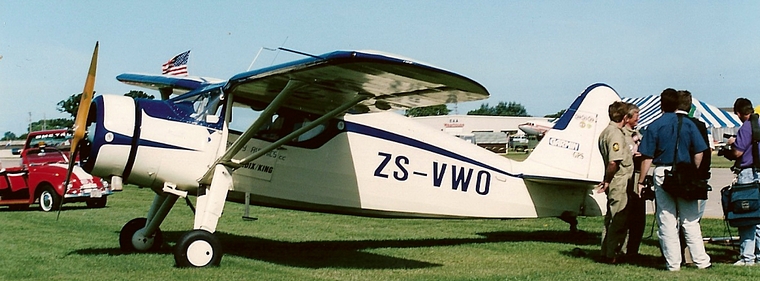
One of the highlights of ZS-VWO's long career came in 1992 when she was granted a Restricted Airworthiness Certificate for a flight to the United States to attend the EAA Annual Convention at Oshkosh.
ZS-VWO at AirVenture
The journey resulted in an impressive 126 flight hours accumulated over just more than three weeks.
For the owner, the trip was particularly significant, describing it as:
“The best thing that ever happened to the Antique/Vintage and Veteran section of the EAA.”
After returning to South Africa, the aircraft was shipped home three years later. Unfortunately, once again, ZS-VWO spent an extended period in a hangar.
The search for suitable engine components eventually paid off. New +0.010-inch pistons, rings, bearings, bushes and other components were sourced, allowing the engine to undergo a complete overhaul. The work was completed and the aircraft was returned to an airworthy condition in February 2001.
Grounded Again
In May 2018, ZS-VWO was grounded after corrosion in the cylinders resulted in increased oil consumption. Once again, finding the necessary parts-and the time and inclination to undertake the work-would take several years.
Eventually, in December 2024, the cylinder barrels and heads were separated and the barrels sent to Aircraft Cylinders of America. They were returned to standard size using the NuChrome process.
The heads and barrels were then reassembled with new pistons, rings and valve springs.
Finally, in July 2025, after another long period on the ground, ZS-VWO took to the skies once again.
She has since accumulated approximately 25 hours following the top overhaul. A new alternator has also recently been fitted after the original unit, which had served for approximately 40 years, finally gave up.
Airframe and Engine
The airframe has accumulated approximately 850 hours recorded in South African service and has no known accident history, apart from an incident involving a previous owner who flew at low level through farm power lines.
The incident damaged the engine cowling. Although a repair had been carried out before the present owner acquired the aircraft, he was not satisfied with the workmanship and undertook a further repair during the restoration.
The riveted patches were removed, the holes welded closed and a new 16 mm aluminium tube was welded into the bull nose, replacing the badly repaired original 4130 tube within the rolled edge of the cowling.
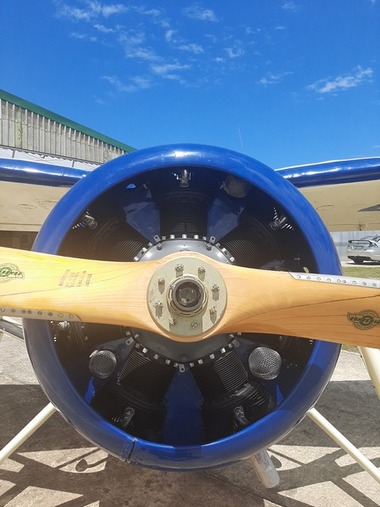
Power is provided by a Warner Super Scarab rated at 165 hp. The engine has accumulated approximately 840 hours total time, including 190 hours since major overhaul and 25 hours since the latest top overhaul.
The aircraft comes with two Sensenich wooden propellers, both recently refurbished and balanced.
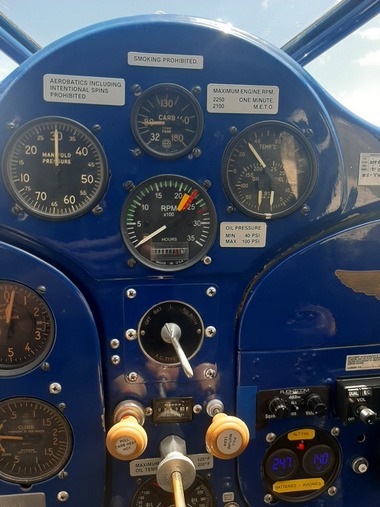
The 69-inch-pitch cruise propeller produces approximately 1,950 rpm static at sea level and 2,000 rpm at 75 mph during the climb. METO is 2,100 rpm, with maximum rpm limited to 2,250 for one minute.
The second propeller is a low-time 67-inch-pitch climb propeller, originally used to improve climb performance while the aircraft was based on the Highveld.
Original Instruments, Modern Essentials
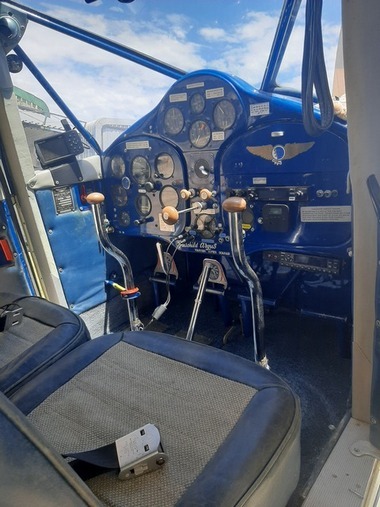
ZS-VWO retains a remarkable connection with her past. All the flight instruments are original equipment dating from her 1941 production.
Modern communications and navigation equipment has nevertheless been added where appropriate.
The avionics include an Icom IC-210 communications radio with FlightCom intercom, a Garmin GTX 327 transponder with blind encoder and a Garmin GPSMAP 296 for navigation.
A Survivor with a Story
Few aircraft can claim a history quite like ZS-VWO.
From the Fairchild production line and wartime RAF service, through her work with the Air Transport Auxiliary, the remarkable 1949 journey from Britain to South Africa, decades of intermittent flying, several restorations, a transatlantic journey to Oshkosh and numerous years spent patiently waiting in hangars, she has survived because people cared enough to keep bringing her back.
Today, following her latest restoration and return to flight in 2025, ZS-VWO once again represents a tangible piece of aviation history.
She is not simply an old aircraft. She is an aircraft that has travelled, served, been restored, crossed an ocean, inspired her owners and survived for more than eight decades.
And now, after all those years, this remarkable Fairchild is looking for her next custodian.